
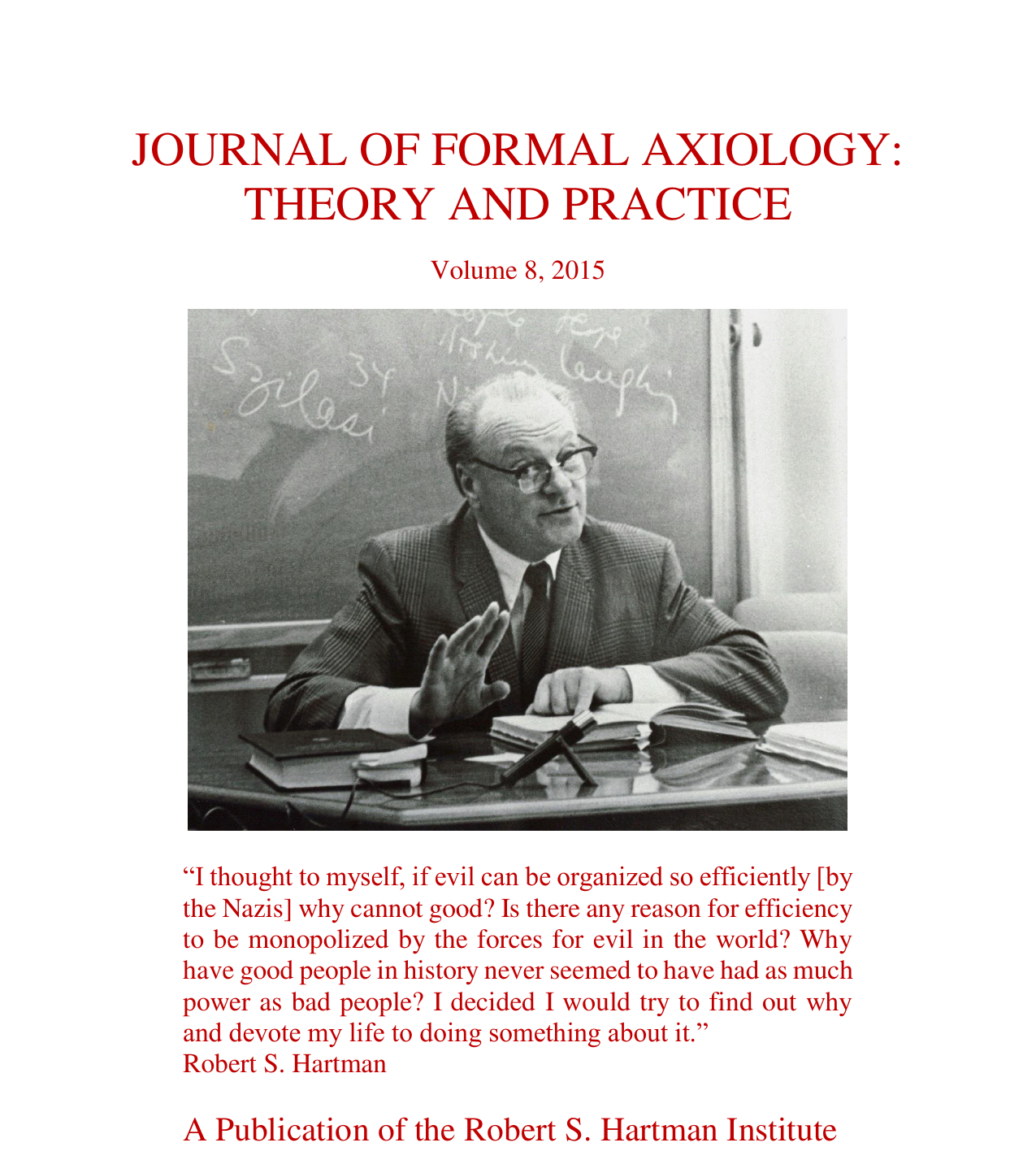
Does Evil Prevail Over Goodness?
DOI:
https://doi.org/10.67945/jfa.v8i.136Keywords:
empirical axiology, Hartman Value Profile, evil, moral psychologyAbstract
This paper reports the results of an empirical study that made use of HVP scores from six convenience samples totaling more than 1,000 respondents, to determine whether respondents’ profiles as measured by the HVP support Hartman’s contention that it is easier to organize for evil than for good. Our findings are that, for the samples studied, respondents’ scores do not support Hartman’s assertion. We found a strong prevalence for the “good” rather than for evil across all six data samples using the HVP scales we analyzed.References
Edwards, Rem B., Ed. (1995). Formal Axiology and its Critics. Atlanta: Rodopi.
Forrest, Frank G. (1994). Valuemetrics. Atlanta: Rodopi.
Forrest, Frank G. (2001). Ethical Decision-Making for the 21st Century, Daytona Beach: Speedway Press.
Hartman, Robert S. (1994). Freedom to Live, Arthur R. Ellis, Ed. Atlanta: Rodopi.
Hartman, Robert S. (1967). The Structure of Value. Carbondale, IL: Southern Illinois University Press.
Hartman, Robert S. (2006). The Hartman Value Profile (HVP) Manual of Interpretation, 2nd Ed., Knoxville, TN: Robert S. Hartman Institute.
Hartman, Robert S. (1995). “Reply to William Eckhardt and Robert S. Brombaugh. 1973.” In Rem B. Edwards, Ed. Formal Axiology and its Critics. Atlanta: Rodopi.
Pomeroy, Leon (2005). The New Science of Axiological Psychology. New York: Rodopi.
Published
How to Cite
License
Copyright (c) 2015 Robert S. Hartman InstituteAll rights reserved. No part of this publication may be reproduced, distributed, or transmitted in any form without prior written permission from the Robert S. Hartman Institute, except as permitted by law.
