Archives
-
Vol. 17 (2024)
This year’s journal includes several empirical studies and philosophical exposés, showcasing the latest thinking around formal axiology. In addition, Cliff Hurst provided an original Hartman writing he found in the archives regarding enlightenment for our own time. The information shared in the journal is timely, if not timeless. The journal showcases new studies and thoughts. Some are original research that advances our knowledge in specific disciplines, while others synthesize concepts from other academics and relate them to formal axiology.
-
Vol. 16 (2023)
This volume presents empirical studies on formal axiology alongside theoretical and philosophical explorations. It features articles about leadership, value combinations, Hartman's Nobel Peace Prize nomination, and the ability to alter value structures. I hope you enjoy each author's contribution.
-
Vol. 15 (2022)
Imagine a one-room house with several doors on each side. There are no windows. You cannot see inside. And the doors are all locked. You don’t have a key. Yet, somehow, you intuit that if you could only get inside, then you would find there some valuable new insight about the theory and practice of formal axiology. Now, imagine that someone walks up to you and hands you a key ring with a hundred keys on it. A dozen doors; a hundred keys. At least one of those keys, for sure, will unlock one of those doors for you. A different key may unlock a different door for someone else. That’s how the editor sees this issue of the Journal. Formal axiology is difficult to comprehend. Yet, the more insight you gain, the clearer becomes your understanding of it. The authors of articles in this issue have provided us with at least a hundred keys by which we may each further our understanding of this theory and its practice.
-
Vol. 14 (2021)
This year's Journal reflects the wide variety of people who are studying and applying formal axiology in the world today, and it reflects the depth of their knowledge and their intellectual rigor. Contributors take up spirituality and worldliness, Hartman's historical connection to Abraham Maslow at MIT, and the axiological patterns behind both educators and unethical leaders. The volume also includes a wide-ranging dialogue among members of the Robert S. Hartman Institute, along with a previously unpublished piece from Hartman's own archive on ethics and economics.
-
Vol. 13 (2020)
A theme emerged as this volume of the Journal of Formal Axiology started to come together. The theme became that of illustrating the evolution of Hartman’s lifelong quest to develop a science of values and valuation. At the core of his quest, of course, was his development of the theory of formal axiology. But formal axiology does not stand on its own as a full-fledged science of values. It needs something more. What that something “more” consists of became the theme of this issue of the Journal. We hope you find it interesting, insightful, and informative.
-
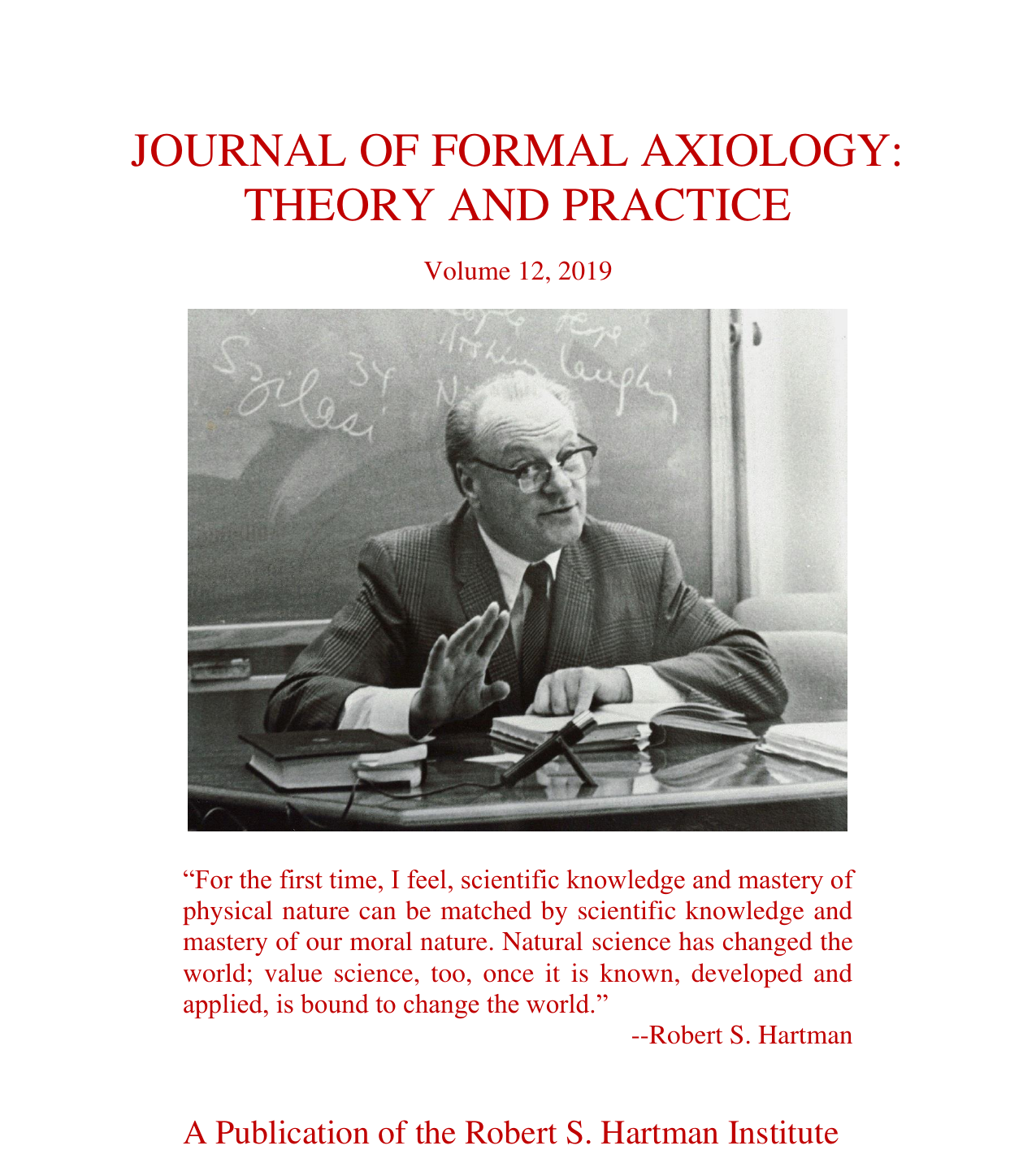
Vol. 12 (2019)
The articles in this 2019 issue reflect the depth and rigor of scholarship from members of the Institute. Continuing a practice begun in 2017, this issue also features a piece of Hartman's own writing — here, 'Four Axiological Proofs of the Infinite Value of Man.' Hartman was a prolific writer, but much of his work went unpublished in his lifetime, and even what did reach print deserves a wider audience today.
-
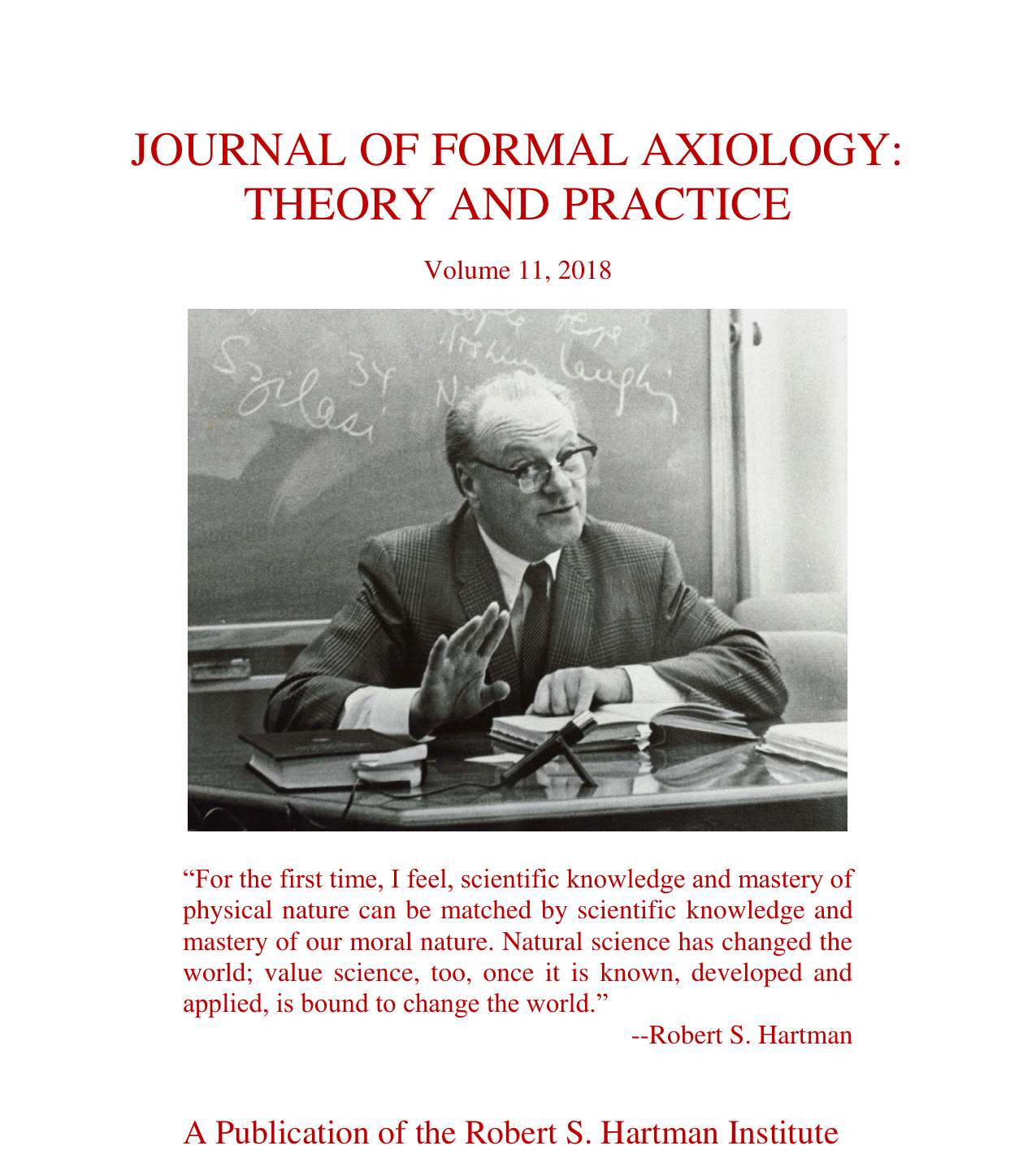
Vol. 11 (2018)
This volume opens with two previously unpublished lectures from Hartman's own series on his work: Lecture IV: The Dimensions of Value and the Science of Value, and Lecture V: Application of the Science of Axiology. Historian Peter Kizilos-Clift traces the backstory of Hartman's time at MIT, where he helped confront a widely held assumption among scientists that science is, and should be, value neutral. Former Hartman doctoral student Mark A. Moore, with co-author Hong Zhang, uses machine learning to analyze degrees of extrinsic value with more precision than Hartman's own use of Pascal's Triangle allowed. And frequent contributor Gilberto Carrasco Hernández continues a discussion begun in 2011 and 2014, proposing a quality model for managing the Evangelical Christian Church through formal axiology.