
Counterfactual Emotions and "Undoing"
The Kahneman/Hartman Discussion
DOI:
https://doi.org/10.67945/jfa.v10i.153Keywords:
Daniel Kahneman, behavioral economics, decision-making, Hartman Value Profile, counterfactual thinkingAbstract
The work of Daniel Kahneman and Amos Tversky on human judgment and decision-making analysis has gained increasing attention over the past generation. Popular books have introduced their work to a growing audience of both professional academics and business and organizational leaders. Kahneman has personally been recognized with a Nobel Prize. It is possible to find strong commonality between Kahneman and Tversky as well as the axiology of Robert S. Hartman. In addition, there are conceptual areas within the Kahneman/Tvesky work that may be beneficially augmented by measures found in The Hartman Value Profile. The focal points of this particular article are counterfactual emotions and their negative impact on good judgments. A counterfactual emotion can result in diminished insight into a problem-solving situation in ways that are very commonplace in the modern world. Hartman’s work may have notable consequences for offsetting the implications of counterfactual decision-making. The data derived from The Hartman Value Profile could precisely constitute something of the “deep knowledge” which Kahneman believes is essential in modern decision-making and so difficult to attain relative to human beings.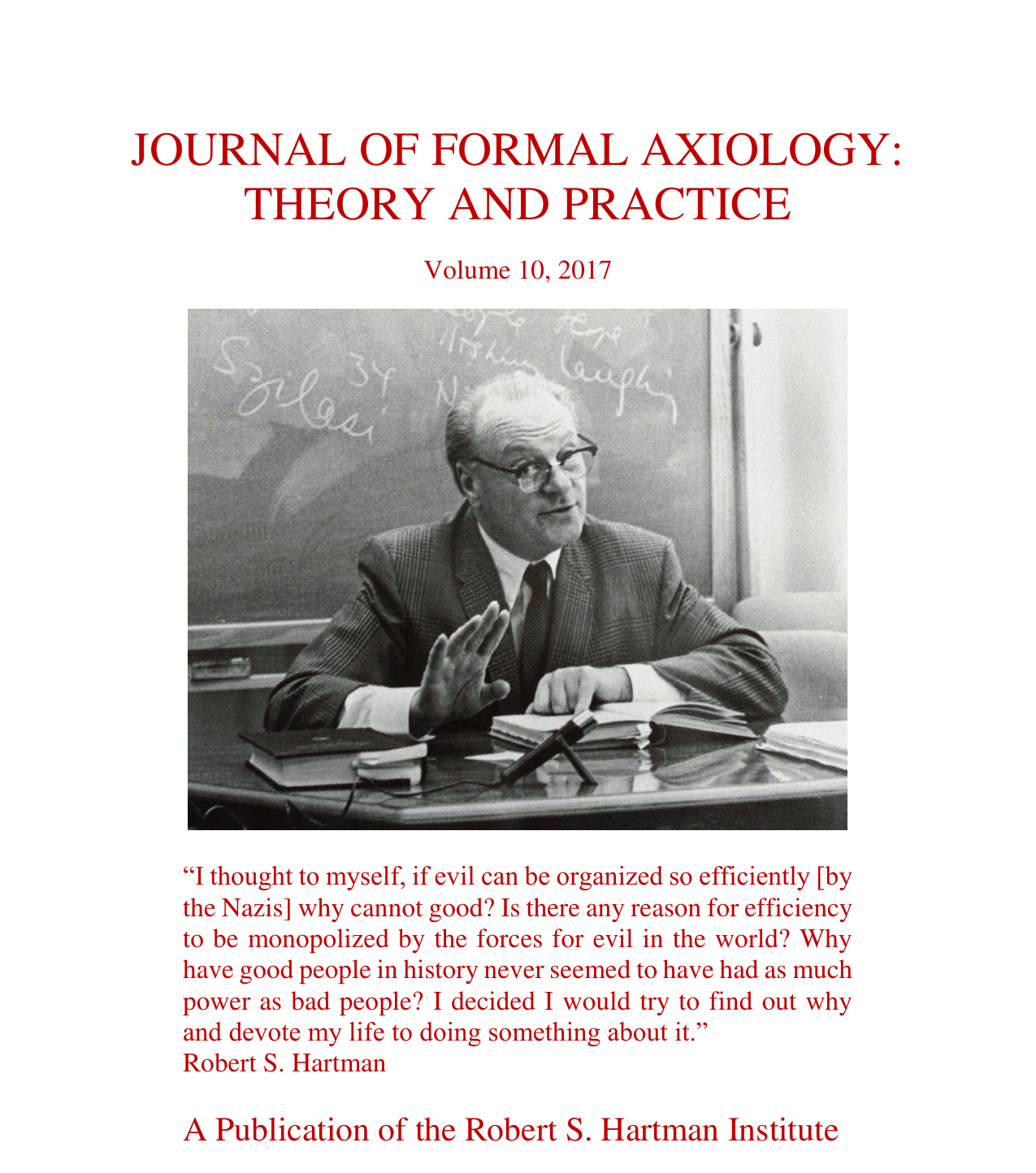
Published
2017-07-01
How to Cite
Byrum, C. S. (2017). Counterfactual Emotions and "Undoing": The Kahneman/Hartman Discussion. Journal of Formal Axiology: Theory and Practice, 10, 43–52. https://doi.org/10.67945/jfa.v10i.153
Issue
Section
Articles
License
All rights reserved. No part of this publication may be reproduced, distributed, or transmitted in any form without prior written permission from the Robert S. Hartman Institute, except as permitted by law.
