
A Unified Field Theory of Motivation
Based on the work of Robert S. Hartman
DOI:
https://doi.org/10.67945/jfa.v4i.89Keywords:
motivation theory, Robert S. Hartman, organizational psychology, Clark HullAbstract
The issue of what causes people to become motivated, engaged, and involved—to do what they do with the intensity that they sometimes express—has been a classic question that has been raised across the ages by human beings in one way or another. Of course, many variables contribute to motivation, and sorting these variables out in an orderly manner has been difficult. The task of this discussion is to find some unity around the work of Robert S. Hartman for the overall conversation involving motivation. In the process of finding focus and direction in Hartman’s thought, the discussion will also look at both modern and classical contributions to motivational theory that parallel and advance Hartman’s thought. In addition to several modern expressions that derive from discussions in contemporary organizational settings, the work of David Brooks and Clark Hull will be featured. The goal of the discussion is to create the image of a “unified field” of integrative factors that together drive human behavior and performance.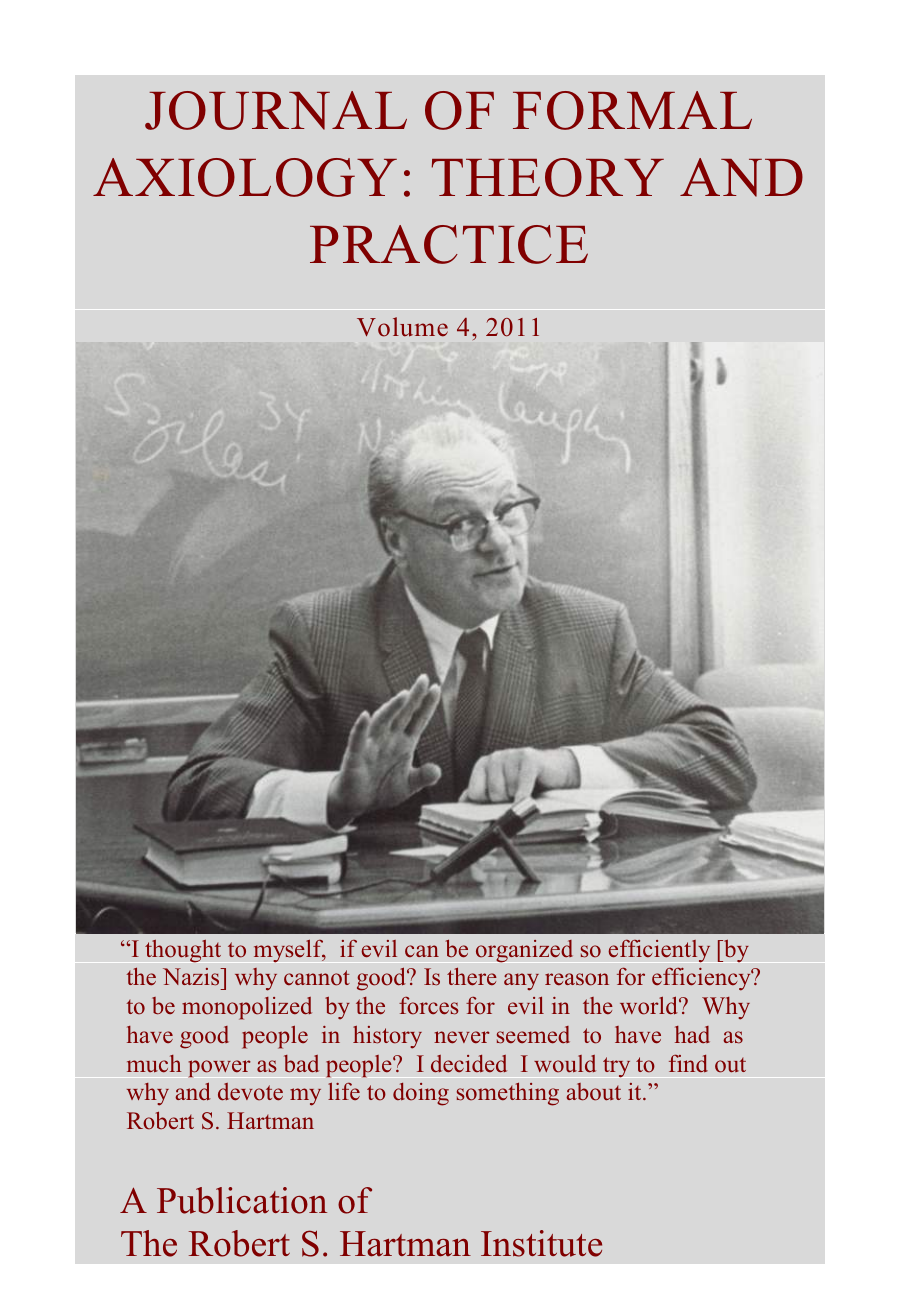
Published
2011-07-01
How to Cite
Byrum, C. S. (2011). A Unified Field Theory of Motivation: Based on the work of Robert S. Hartman. Journal of Formal Axiology: Theory and Practice, 4, 13–52. https://doi.org/10.67945/jfa.v4i.89
Issue
Section
Articles
License
All rights reserved. No part of this publication may be reproduced, distributed, or transmitted in any form without prior written permission from the Robert S. Hartman Institute, except as permitted by law.
