Taming the Beast by Declawing the Systemic
DOI:
https://doi.org/10.67945/jfa.v5i.100Keywords:
systemic value, formal axiologyAbstract
Formal axiologists seem “systemaphobic,” that is, we are wary of the destructive power of the systemic. In this we show we are the true children of Robert S. Hart- man, who escaped from Nazi Germany. Accordingly, we keep the systemic chained in the basement where it can’t rise in tyrannical power to threaten life as Hitler once did through his ideologies. Yet, ideology and conceptualization are how we make sense of the world. Without the systemic, life literally would have no meaning. More accurately, without the systemic we would have no way to perceive or discuss whatever meanings life might contain. In short, we would be blind to the realities around us and live lives of utter chaos. The author contends that we need to bring the systemic up into the light of day and establish its equal place with the other value dimensions. We do not need to suppress or repress the systemic in order to control it. Rather we need to understand it in light of reality. The author suggests that there may be a “bold S” which defines reality and a “skinny S” that represents the mental models we build in our attempts to fathom or at least accommodate reality. If we can split the S, the result will be humility. No one is big enough to own or even shape the bold S. Our humble acknowledgment of that fact may declaw our skinny S making it “safe to have around the children.” With the family of values reunited, we may make better progress in our continuing quest to understand just what it was that Hartman gave us, how better to share it in a postmodern age, and how to develop his ideas beyond where he left them.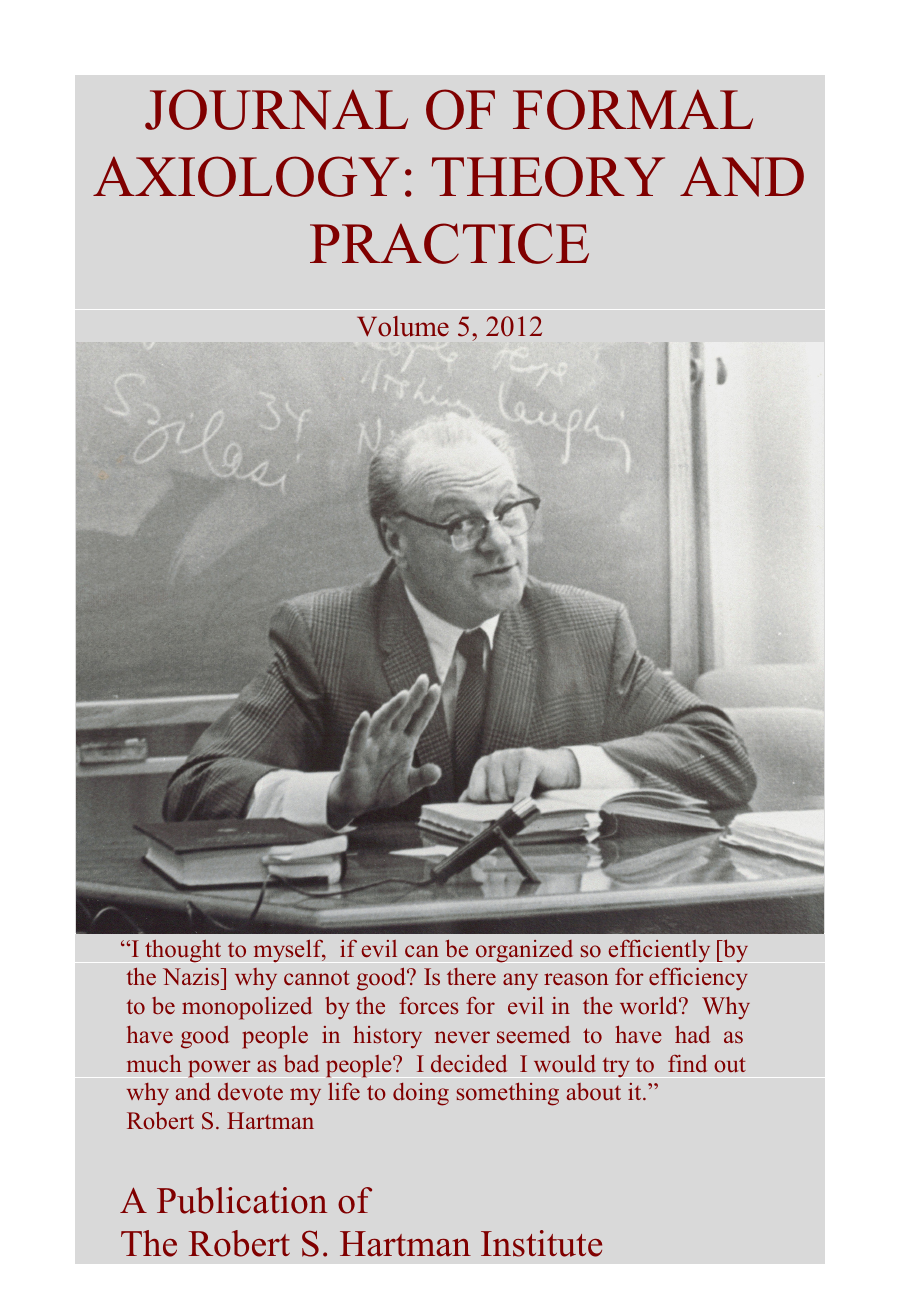
Published
2012-07-01
How to Cite
Weller, J. C. (2012). Taming the Beast by Declawing the Systemic. Journal of Formal Axiology: Theory and Practice, 5, 89–100. https://doi.org/10.67945/jfa.v5i.100
Issue
Section
Articles
License
Copyright (c) 2012 Robert S. Hartman InstituteAll rights reserved. No part of this publication may be reproduced, distributed, or transmitted in any form without prior written permission from the Robert S. Hartman Institute, except as permitted by law.
