
The Fifth Dimension
Intrinsic Value Enhancers
DOI:
https://doi.org/10.67945/jfa.v6i.114Keywords:
intrinsic value, value theory, emotions, formal axiologyAbstract
This article argues for recognizing another independent kind or dimension of value that does not fall into Hartman’s three systemic, extrinsic, and intrinsic dimensions. They are called “Intrinsic Value Enhancers.” They exist only within unique conscious individuals (intrinsic value objects), but they are not themselves conscious individuals. Neither are they mere concepts or beliefs (systemic valued) or merely mindless but useful sensory objects and processes (extrinsic values). They are such things as pleasures or happiness, creativity, free choice, will power, self-initiative, spontaneity, concentration, attention power, positive feelings and emotions of every description such as desires, appetites, moods, attitudes, affections, purposes, interests, approvals, moods, enjoyments, attitudes, etc., conscience, our inner moral compass that tells us the difference between right and wrong, love, empathy, compassion, etc. All such things enrich our lives and are good for us, but they have no value to, for, or in themselves. Some of these are ways of valuing or valuation, but they are also value-objects of a distinctive kind.References
Edwards, Rem B. The Essentials of Formal Axiology. Lanham, MD: University Press of America, 2010.
Hartman, Robert S. The Structure of Value. Carbondale and Edwardsville, IL: Southern Illinois University Press, 1967. Republished in 2011 by Wipf & Stock, Eugene, OR.
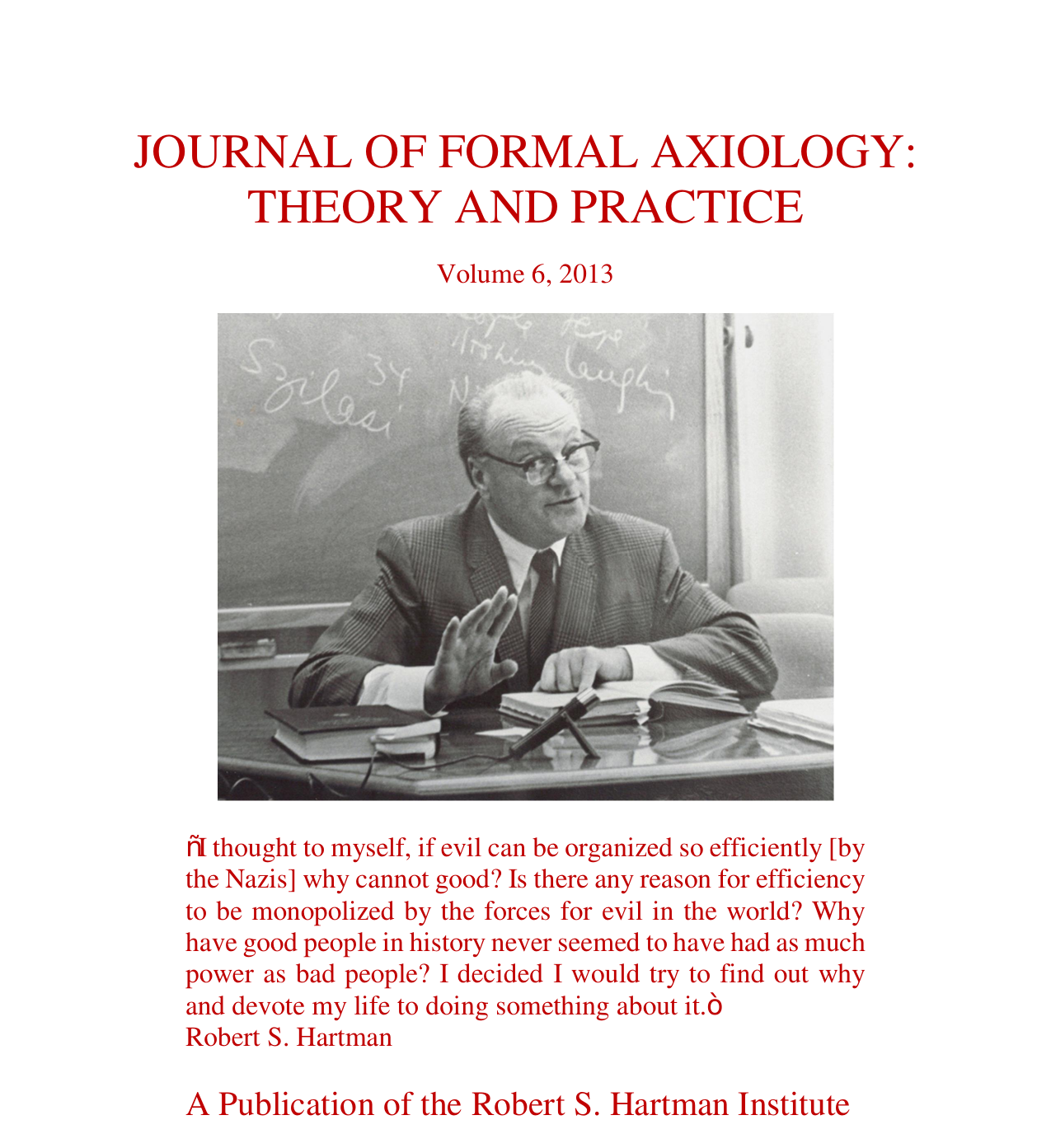
Published
2013-07-01
How to Cite
Edwards, R. B. (2013). The Fifth Dimension: Intrinsic Value Enhancers. Journal of Formal Axiology: Theory and Practice, 6, 55–60. https://doi.org/10.67945/jfa.v6i.114
Issue
Section
Articles
License
All rights reserved. No part of this publication may be reproduced, distributed, or transmitted in any form without prior written permission from the Robert S. Hartman Institute, except as permitted by law.
